
Hidalgo County Court Records After a Jail Arrest
Hidalgo County has a direct local path from jail records to criminal court records because the Hidalgo County Records Inquiry portal includes both jail searches and criminal case searches. The jail side starts with arrest, intake, booking number, booking date, release date, and bond-status filters. The court side starts when charges are filed or pursued in a criminal case. A person can appear in the jail search before a matching case is visible in the criminal case search.
Use jail inmate records for the custody and booking side of the event, including searches by defendant, booking number, date of birth, booking date range, release date range, and bond status. Use jail roster mugshots for the separate question of booking photos, with the important caveat that Hidalgo research did not verify a public booking-photo feed. Court records after an arrest focus on filed charges, settings, dispositions, and case status.
The local prosecutor channel is the Hidalgo County Criminal District Attorney, and formal court records are searched through the criminal case records function of the Records Inquiry portal. The portal notice treats web copies as public-access, unofficial, informal records. Certified or official copies should be requested from the proper clerk rather than treated as automatically certified because they were visible online.
The Hidalgo County criminal case search is available through the Criminal Case Records search. The screenshot below comes from that official search route.
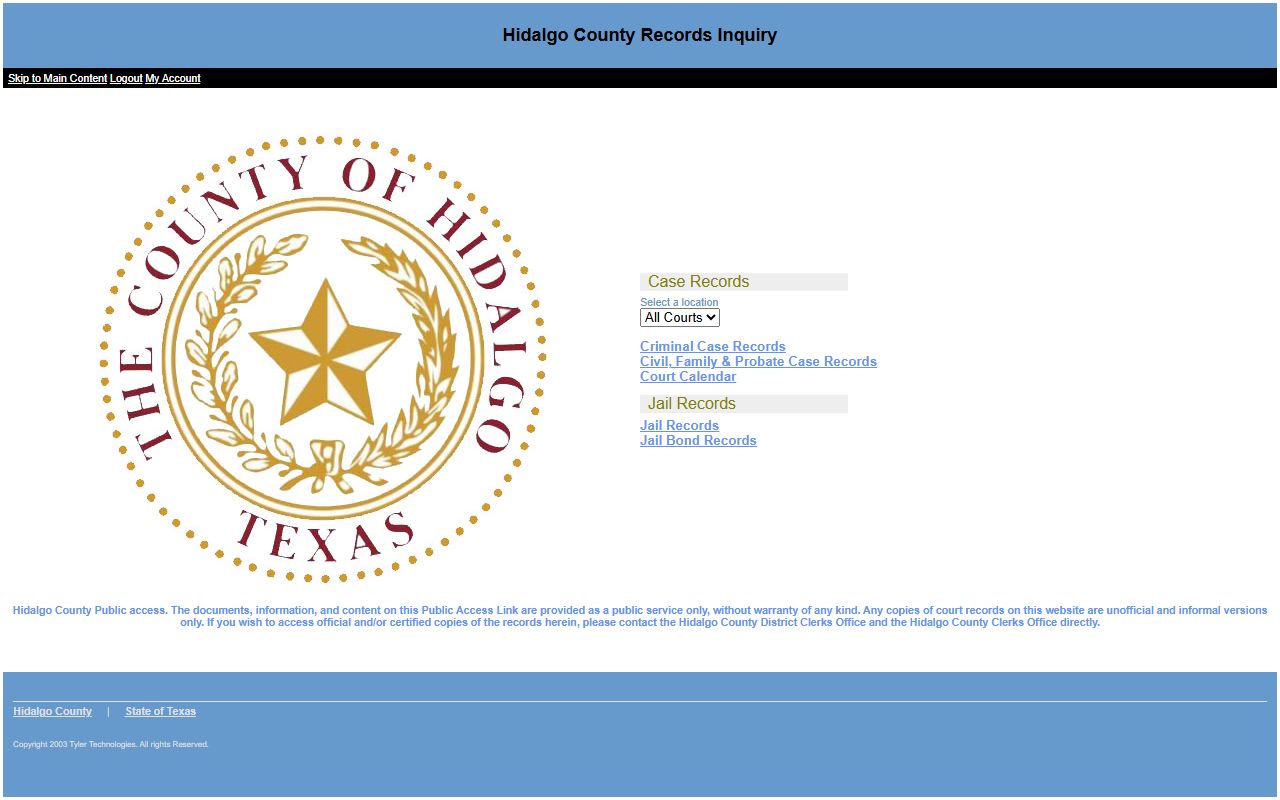
That court search is the best starting point once the question changes from where someone is held to what criminal case was filed after the jail arrest.
How to Find Court Records After an Arrest
Start with the jail record when the arrest is recent. The Hidalgo County Records Inquiry Jail Records search can confirm the spelling of the defendant name, a booking number, booking date range, and whether the person has been released. Those details reduce false matches in a county where common surnames and similar names can produce multiple court results.
- Open the Hidalgo County Records Inquiry and choose Criminal Case Records.
- Search by defendant name, using last name, first name, middle name, and date of birth when known.
- If the jail or bond record provides a case number, search by case number instead of name.
- Use case status, filed-date range, judicial officer, setting-date range, case type, hearing type, and sort controls to narrow a crowded result list.
- Open likely matches and compare identity, filing date, arrest date, charge descriptions, court, settings, and status.
- Request official or certified copies from the clerk if a legal, court, employment, immigration, licensing, or housing decision depends on the document.
Do not assume the first result is the same person. A reliable match usually combines name, date of birth, case number, booking date, filing date, and charge context. If the court search has no result, the prosecutor may not have filed yet, the charge may have been declined, the case may be in a different court, or the identifying information may differ from the jail record.
Hidalgo Court Case Search Fields
The Criminal Case Records screen supports several search modes. Case-number searches are useful when a booking or clerk record gives an exact identifier. Defendant searches are more flexible but need careful narrowing. Citation and attorney searches can help when those identifiers are known.
| Field or Control | Use | Notes |
|---|---|---|
| Search By | Case, Defendant, Citation, or Attorney | Choose the mode that matches the identifier available. |
| Exact Name / Soundex | Name matching | Exact name limits results; Soundex broadens similar-sounding names. |
| Case Number | Direct case lookup | Use when a jail, bond, clerk, or attorney record provides the case number. |
| Citation Number | Citation lookup | Helpful for cases tied to a citation rather than only a booking record. |
| Last, First, Middle Name | Defendant or attorney name | Last and first name are marked for name mode; middle name can narrow matches. |
| State, Date of Birth, Driver's License | Identity filters | Use date of birth when available to avoid confusing two defendants. |
| Case Status | All, Open, or Closed | Open cases are active; closed cases have a closing event or disposition. |
| Date Filed Range | Filed on or after / before | Useful when the arrest date is known but the case number is not. |
| Judicial Officer | Court assignment filter | Options were visible as a filter label, but full options were not captured. |
| Setting Date Range | Hearing calendar filter | Can locate cases with upcoming or past hearing dates. |
| Case Types / Hearing Types | Case narrowing | Labels were visible; full option lists were not captured in research. |
| Sort By | Case Number, Filed Date, Filed Date Rev, Status, Defendant Name | Sort by filed date or defendant name when reviewing several possible matches. |
Charging Documents After a Hidalgo County Arrest
A jail record may list an arrest charge before the formal case is complete. The charging document is the court-facing instrument that turns the accusation into a filed case. In Texas criminal practice, the document may be a complaint, an information, or an indictment depending on the offense level and procedural posture.
| Document | Who Usually Initiates It | Common Use | Why It Matters |
|---|---|---|---|
| Complaint | Officer or prosecutor | Often starts early criminal proceedings | May support arrest, probable cause, or a misdemeanor case. |
| Information | Prosecutor | Many non-indictment prosecutions | Shows the prosecutor's filed charge rather than only the booking label. |
| Indictment | Grand jury | Felony prosecution where indictment is required or used | May replace or refine earlier arrest-charge language. |
Because the Hidalgo County Criminal District Attorney reviews cases after arrest, the filed charge can be different from the jail intake description. Charges may be accepted, rejected, amended, reduced, enhanced, dismissed, or refiled. That is why court records after a jail arrest should be read as the later legal record, not just a duplicate of the booking entry.
Charge Status in Court Records After Arrest
Charge status describes where a case or count stands in the court process. Hidalgo portal status choices include All, Open, and Closed. Individual cases may also show events or dispositions that explain whether a charge remains pending, was dismissed, was amended, or resulted in a conviction or supervision outcome.
| Status Term | Plain Meaning | Important Caution |
|---|---|---|
| Pending | The charge or case remains unresolved. | A pending charge is an accusation, not a conviction. |
| Open | The portal status indicates an active case. | Open status does not explain guilt, bond eligibility, or final outcome by itself. |
| Closed | The case has a closing event or disposition. | Read the disposition before assuming the result was conviction or dismissal. |
| Dismissed | The prosecutor or court did not proceed to conviction on that charge. | A dismissal does not automatically remove the arrest record from every system. |
| Reduced | The charge changed to a lesser offense. | The booking charge may look more serious than the final filed charge. |
| Amended | The charge wording, count, or legal basis changed. | Compare dates and documents to understand which version controls. |
| Convicted | The court entered a conviction after plea, verdict, or other qualifying disposition. | Sentencing, appeal, supervision, or custody records may be separate. |
| Deferred / Community Supervision | A Texas supervision result that can have special legal consequences. | Eligibility for later relief depends on the exact disposition and law. |
Bond and Release Records After an Arrest
Bond details are not limited to the criminal case search. Hidalgo County Records Inquiry has a separate Jail Bond Records search that can search by defendant or bond company. The form supports booking date, release date, posted date, and bond status filters, with All, Open, and Closed as bond-status choices.
| Bond Type | How It Works | Local Search Note |
|---|---|---|
| Cash bond | Money is posted directly to secure appearance. | Verify current release eligibility with the jail before paying. |
| Surety bond | A bail bond company or surety posts the bond. | The Hidalgo bond search can be run by bond company. |
| Personal / PR bond | Release is based on a promise to appear, sometimes with conditions. | Court conditions may appear in case records. |
| Property bond | Real property is pledged as security. | Usually requires more paperwork than a simple online lookup shows. |
| No-bond / hold | Release is blocked until the court or holding agency changes the status. | One bondable charge does not clear another hold. |
Holds can involve an ICE detainer, parole blue warrant, warrant from another county, federal hold, probation or parole matter, no-bond court order, or a new charge for which bond has not been set. When custody status and court status conflict, verify directly with the Hidalgo County Sheriff's Office, jail staff, counsel, or the court handling the case.
Warrants, Court Records, and Arrest Results
No dedicated official Hidalgo County Sheriff's active-warrant search was verified in the research. Treat warrant lookups conservatively. If a warrant has already resulted in booking, the person may appear in Jail Records. If a court issued a bench warrant, capias, or failure-to-appear order, the related criminal case record may show history, settings, and status if those entries are public.
Municipal court warrants, justice court matters, out-of-county holds, and parole blue warrants may not be visible as a simple county jail search before arrest. People trying to resolve a possible warrant should contact the issuing court, clerk, attorney, or appropriate law enforcement office. Do not rely on a negative roster result as proof that no warrant exists.
Charge vs. Conviction
An arrest charge is an accusation connected to a booking or filing decision. A conviction is a later court outcome. Hidalgo County court records after an arrest may show both the original filed charge and later outcomes, but those entries must be read in sequence.
| Question | Charge | Conviction |
|---|---|---|
| Stage | Early accusation or filed count after arrest. | Final court result after plea, verdict, or qualifying disposition. |
| Proof level | Based on probable cause and prosecutor filing standards. | Requires proof beyond a reasonable doubt or a valid plea. |
| Record effect | Can appear in jail records, court filings, and pending-case indexes. | Can affect sentencing, supervision, state custody, and criminal-history reporting. |
| Best source | Jail Records, Criminal Case Records, and charging documents. | Final judgment, disposition entries, and certified court copies. |
Sealed vs. Expunged Arrest Records
Texas Code of Criminal Procedure Chapter 55 governs expunction for qualifying criminal records. Sealing or nondisclosure is a different form of relief and does not mean the same thing as expunction. Eligibility depends on the case result, timing, offense type, criminal history, and court order.
| Question | Sealed / Nondisclosed | Expunged |
|---|---|---|
| Public visibility | Restricted from ordinary public access. | Treated as removed under the expunction order. |
| Agency access | Certain agencies may retain limited access depending on law. | Access is much narrower and controlled by the order and statute. |
| Typical path | Court order after an eligible disposition. | Court order under Chapter 55 for qualifying arrests and outcomes. |
| Practical step | Confirm the exact order and affected agencies. | Confirm that every listed agency received and processed the order. |
Texas Public Access Rules for Court Records After Arrest
Texas Government Code Chapter 552, the Texas Public Information Act, gives the public a right to inspect or copy governmental information subject to exceptions. Section 552.021 states the basic availability rule for public information during normal business hours. Section 552.108 permits law-enforcement and prosecution exceptions for certain records, while basic information about an arrested person, an arrest, or a crime is treated differently from investigative detail.
The Texas Government Code Section 552.108 screenshot below is a matched source for the law-enforcement exception used in public-record decisions.
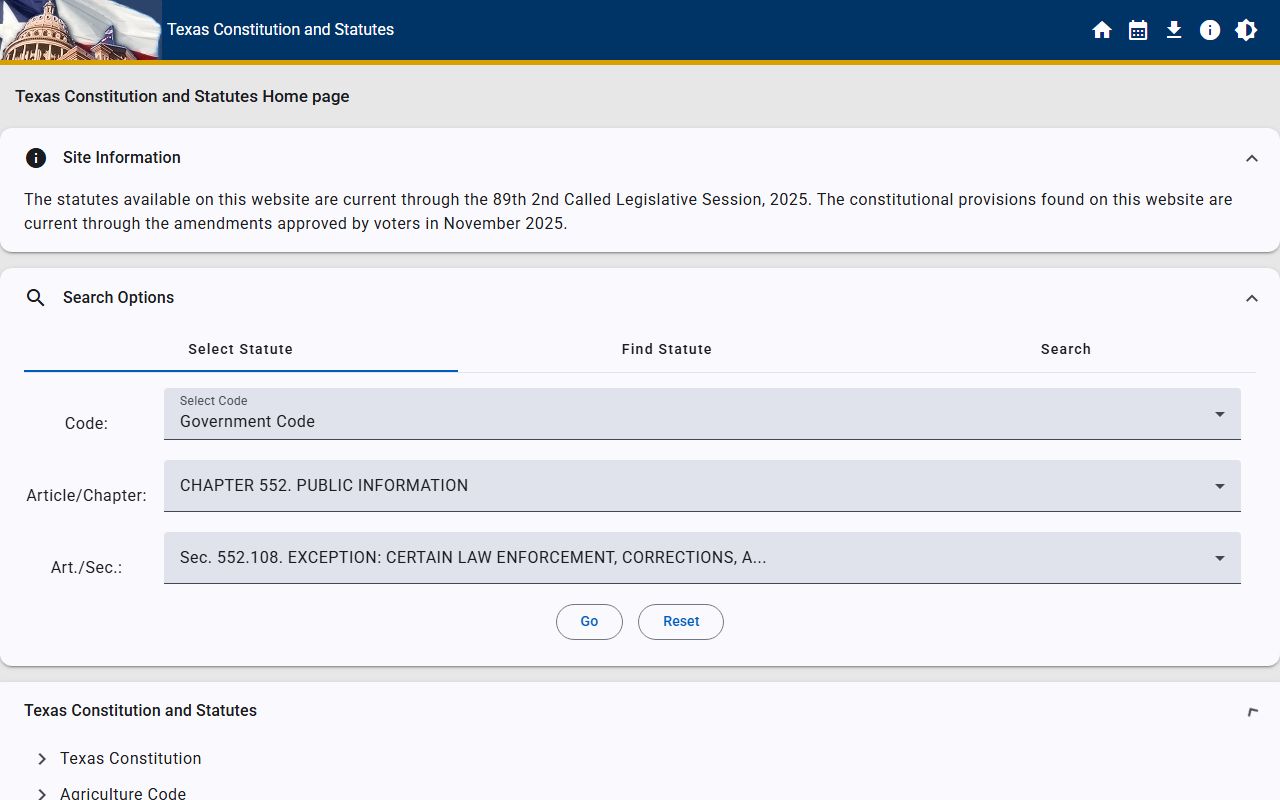
For Hidalgo County records not visible in the online portal, the Open Records Division is the public-information fallback. Send a focused request with the person's full name, date of birth if known, booking number, booking date, case number, arresting agency, and the exact document or record being requested.
Restricted Court Records After a Hidalgo County Arrest
Not every record connected to an arrest is publicly available online. Juvenile records, sealed matters, expunged records, active investigative details, confidential victim information, medical or mental-health information, and certain law-enforcement materials can be withheld or redacted. Portal results may also be incomplete, delayed, or limited to public-index information.
FCRA notice: Hidalgo County Inmate Population is not a consumer reporting agency, and site information may not be used for employment, credit, housing, insurance, or other FCRA-covered decisions.